
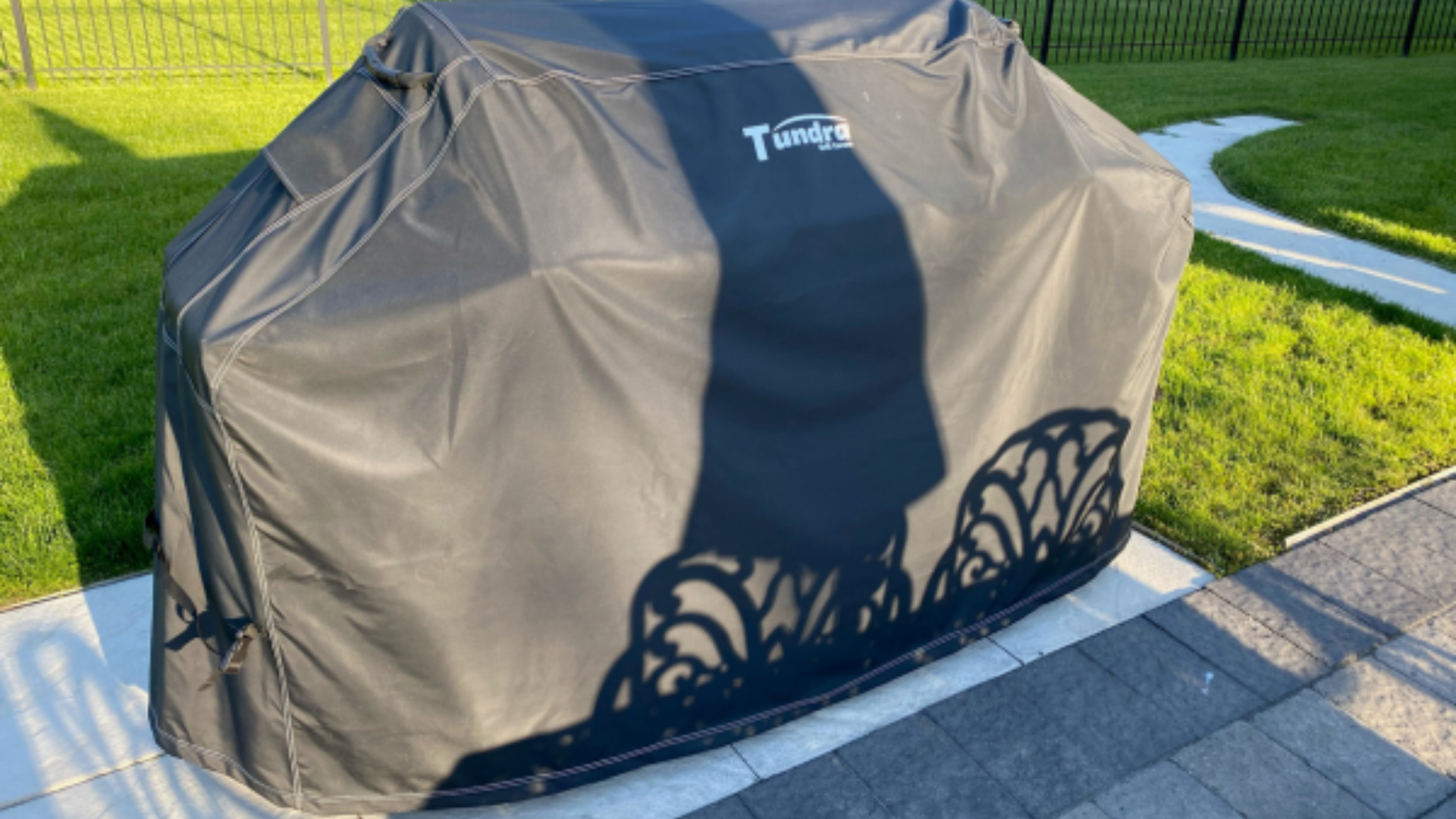
Best BBQ Cover for Canadian Seasons: Buyer's Guide
Posted by Outdoor Covers Canada on 25th Jun 2026
How to Choose a BBQ Cover That Lasts Through All Canadian Seasons: A Technical Buyer's Guide
Key Takeaways
- A grill cover for year-round Canadian use needs 600 denier fabric or heavier, with a composite construction to resist UV degradation in summer and cracking in sub-zero temperatures.
- Top-mounted vents with rain hoods are the only vent design that releases trapped moisture without letting precipitation in. Mid-height or bottom vents do not function correctly because warm moisture rises.
- Cinch-strap securing systems outperform Velcro tabs in high-wind conditions and over multiple seasons of use.
- Length is the critical measurement — most gas grills measure 48"–72" end-to-end at the side tables. Height and depth tolerances are wider.
- Cover spend should generally scale with grill investment. A heavy-duty composite cover in the $80–$120 range is the typical replacement-cost threshold.
Outdoor cooking in Canada is more than a seasonal activity for a significant share of grill owners. Between Pacific coast humidity, prairie wind-chill, Ontario freeze-thaw cycles, and Atlantic salt air, a gas or charcoal grill faces a wider range of environmental stress than equipment in most other markets. The cover is the only barrier between a multi-hundred-dollar appliance and that stress.
Many everyday BBQ covers found at big-box retailers are built for mild climates, leaving them under-equipped for harsh Canadian winters. While these standard polyester covers have an accessible upfront price, they rarely survive past a single season in freezing temperatures. Replacing a weather-worn cover every year quickly adds up, making a single investment in a durable, climate-specific cover the most cost-effective choice for your grill.
This guide walks through the four technical specifications that determine whether a cover will last: material construction, ventilation design, securing mechanism, and sizing. Each is covered in the depth needed to evaluate any product on the market — not only those sold by Outdoor Covers Canada.
Best BBQ Cover Material For Canadian Weather
Denier Rating and Why It Matters
Denier measures the linear mass density of fibres in a fabric. Higher denier means thicker, more abrasion-resistant threads. For BBQ covers exposed to Canadian conditions, 600 denier is the practical minimum. Lighter weights, typically 150–300 denier polyester, will tear at corners, abrade against grill knobs and side tables, and lose structural integrity within a season. Heavier fabrics also resist wind lift more effectively. A cover that is repeatedly flapped against the grill in a windstorm will fail at the seams before the fabric wears out.
Single-Layer Fabrics vs. Composite Construction
The relevant distinction is less "polyester vs. vinyl" and more single-layer fabric vs. multi-layer composite.
- Single-layer polyester or polyethylene: Degrades under UV exposure within 12 months. Becomes brittle in temperatures below approximately -15°C. Common in covers under $40.
- PU-coated polyester: Adds water resistance but does not address cold-weather brittleness or UV degradation meaningfully.
- Multi-layer composite (woven outer + waterproof membrane + soft inner): Maintains flexibility at low temperatures, blocks UV at the outer layer, and provides a true waterproof barrier rather than water-resistance.
A simple in-store test: scrunch the fabric in your hand. If it crinkles stiffly at room temperature, it will be significantly worse at -20°C. A quality composite responds softly and recovers its shape.
UV and Cold-Weather Performance
Most product pages list "waterproof" but few list UV rating or cold-weather flex rating. When this information is missing, assume the cover is not engineered for either condition. For year-round Canadian use, both must be specified by the manufacturer.
Why Ventilation Matters In A BBQ Cover
A fully sealed waterproof cover is, paradoxically, a problem. Heat from the cooling grill and ambient humidity creates condensation inside the cover. With nowhere to escape, that moisture sits against the grill's metal surfaces and accelerates corrosion, often more aggressively than open-air exposure would. The fix is correct ventilation.
Why Vent Placement Matters
Warm, moist air rises. A vent placed mid-cover or near the bottom does not release that air, instead trapping at the top where there is no exit. Vents should be located at the high points of the cover.
Why Vent Design Matters
A simple mesh opening releases air but also admits rain, snow, and insects. A hooded vent with a small overhang above the mesh opening allows upward airflow while blocking downward precipitation. This is a small detail that distinguishes engineered covers from generic ones.
How To Choose A Wind-Resistant BBQ Cover
A cover that blows off in a windstorm is a cover that is not protecting anything. Worse, repeated wind lift damages the seams and eventually destroys the cover from the inside out.
Common securing mechanisms, ranked by durability:
- Cinch straps with side-table routing — Pulls the cover tight under the grill's side tables. Holds in high wind. Releases quickly without bending.
- Bottom drawstring — Functional but tends to loosen over time and can be awkward to operate in cold weather.
- Clip-and-strap (under-grill buckle) — Effective but slower to engage and disengage.
- Velcro tabs — Lose grip within a season; fail completely once dirt accumulates in the hook fabric.
Buyers in exposed locations such as lakefront properties, prairie homes,and balcony grills should treat the securing system as a major deciding factor when shopping for covers.
Choosing The Right BBQ Cover Size
Manufacturer sizing is inconsistent across brands, so generic "small/medium/large" labels are not reliable. Measure the grill yourself.
- Length (end-to-end, including side tables): This is the critical dimension. Most gas grills fall between 48" and 72". Some larger units extend to 96".
- Depth (front-to-back): Typically 24"–28" for residential gas grills. Tolerance is wider here.
- Height (top of lid to base): Typically 42"–52". Provided the cover skirts below the grill's main body, exact height is less critical.
A cover that is too large flaps in the wind and admits more debris. A cover that is too short exposes the burner controls and lower body to precipitation. Match the length first, then verify depth and height fall within the stated range.
|
Feature |
Basic Retail Cover |
Premium Cover (e.g., Tundra Supreme) |
|
Material |
150–300 denier single-layer polyester |
1000D heavy-duty composite polyester |
|
Waterproofing |
Water-resistant (sheds light rain only) |
100% waterproof outer shell |
|
UV & Cold Resistance |
Degrades quickly; brittle below -15°C |
UV-treated; stays flexible down to -40°C |
|
Wind Protection |
Velcro tabs or simple bottom drawstrings |
Side tension cinch straps |
|
Lifespan |
1 season (sometimes 2 if stored inside) |
5 to 7 years in year-round weather |
Tundra Grill Covers Available From Outdoor Covers Canada
Outdoor Covers Canada’s Tundra Grill Cover line is designed specifically for the Canadian climate range: from coastal humidity to prairie cold. The product line uses 600+ denier composite construction, top-positioned hooded vents, and the cinch-strap securing system described above. Sizing runs from 52" through 96" to accommodate residential grills through to larger outdoor-kitchen installations.
As a Canadian-owned business based in Mississauga, Ontario, Outdoor Covers Canada develops products specifically for Canadian weather conditions rather than general international markets. In addition to its standard product range, the company also offers locally fabricated custom covers in Ontario for applications requiring a tailored fit. Tundra Grill Covers start at $79.
To compare cover specifications across grill sizes from 52" to 96", visit outdoorcovers.ca.
Frequently Asked Questions
A multi-layer composite of 600 denier or higher is the standard for Canadian year-round use. Composites combine a UV-resistant woven outer layer, a waterproof membrane, and a soft inner lining that remains flexible in sub-zero temperatures. Single-layer polyester, polyethylene, or basic PU-coated fabrics typically degrade within one Canadian winter and are not a cost-effective long-term choice.
Yes. An uncovered grill exposed to snow, freeze-thaw cycles, and road salt in the air will corrode significantly faster than a covered one. The cover must be properly ventilated, because a fully sealed cover traps condensation against the grill's metal surfaces. A vented, breathable cover protects against precipitation, UV exposure, and debris through all four seasons.
A quality composite cover with proper construction should last five to seven years under year-round Canadian conditions. Single-layer covers typically last one season, sometimes two if stored indoors during winter. Lifespan depends on fabric weight, UV resistance, seam construction, and how the cover is secured against wind, which causes most premature failures.
Measure your grill's total length from the outer edge of one side table to the outer edge of the other — this is the most important dimension. Then measure depth (front-to-back) and height (lid top to base). Match the length first; depth and height typically have wider tolerance. Most residential gas grills fall between 48" and 72" in length.
There is a meaningful difference between "water resistant" and "waterproof." Water-resistant covers (most PU-coated fabrics) shed light rain but allow moisture through in sustained precipitation. True waterproof covers use a sealed membrane layer within a composite construction. Always check whether the manufacturer specifies waterproof rating versus water-resistant, and verify seam sealing on the product specifications.
This is almost always a ventilation problem. A sealed waterproof cover traps moisture from a cooling grill or ambient humidity, and that moisture has nowhere to escape. Mould and mildew grow on the trapped condensation. The solution is a cover with high-positioned hooded vents that allow warm air to rise and exit while preventing rain and snow from entering.
A cover should fit snugly enough that wind cannot lift or flap it significantly, but loose enough to slip on and off without forcing the fabric over corners. Cinch-strap systems allow the cover to be drawn tight under the side tables after fitting. A cover that requires force to install will stress the seams and fail prematurely at stress points.
The differences are fabric weight (denier), construction (single-layer versus multi-layer composite), vent design (placement and hooding), and securing mechanism (cinch strap versus Velcro). A $25 cover typically uses 150–300 denier single-layer material with basic mesh vents and Velcro tabs. A $80–$120 cover typically uses 600+ denier composite construction with hooded top vents and cinch straps engineered for multi-season use.