
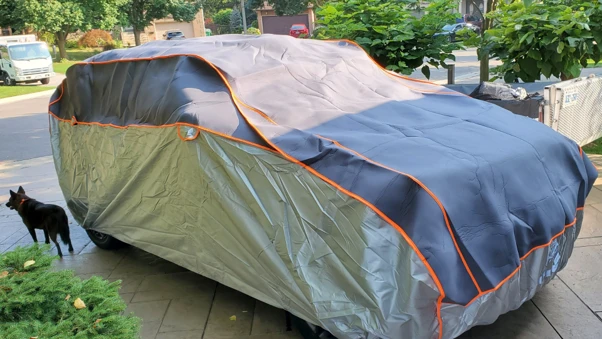
The benefits using a Car Cover to protect your car
Posted by Outdoor Covers Canada on 20th Sep 2016
Top 5 Elements of Our Hail Prevention Car Covers
What are Hail Prevention Car Covers?
Hail prevention car covers are padded, temporary-use vehicle covers designed to absorb the kinetic energy of falling hailstones before they can dent paint, panels, or glass. Unlike standard weatherproof car covers, hail covers utilize a dense, shock-absorbing core for storm emergencies. Severe hail can cause significant vehicle and property damage across Canada, including the Prairies. First-hand storm data highlights the financial risk to drivers, with vehicles accounting for about a third of insured damage across the Prairies.
The hail car covers in Outdoor Covers Canada's automotive covers collection are Venture hail protection covers, built from three materials arranged into five functional elements. Each element addresses a specific failure point that generic covers leave exposed.
- A 5 mm EVA Foam Impact Core: Compresses on impact to absorb and disperse a hailstone's energy across the roof, hood, trunk, and glass.
- A Soft Polyester-Cotton Liner: Sits directly against the clear coat to prevent surface scratches and abrasion while the cover is deployed.
- A 150D Silver Polyester Side Skirt: A lightweight, water-repellent lower section that makes the cover easy to deploy quickly without adding unnecessary bulk.
- Elasticated Hems and Under-Body Straps: Essential heavy-duty anchors designed to keep the cover securely fastened during the high winds that accompany severe thunderstorms.
- Dual Side Vents and Reflective Piping: Integrated vents reduce wind ballooning, while reflective seams ensure your vehicle remains highly visible on dark, stormy streets.
Key Takeaways
- Hail prevention car covers work by absorbing impact energy in a padded core; a 5 mm EVA foam layer is what separates them from standard car covers, which offer no meaningful impact protection.
- The Venture hail covers sold by Outdoor Covers Canada are rated for hail up to 12 mm in diameter falling at 70 km/h, which provides protection within the manufacturer's stated 12 mm / 70 km/h impact rating; larger stones may cause damage.
- The five elements are an EVA foam impact core, a soft polyester-cotton liner, a 150D water-repellent side skirt, elasticated hems with under-body straps, and dual vents with reflective seams.
- Hail car covers are for temporary storm use only; for daily protection, a breathable four-layer all-weather car cover is the correct product.
- Sizes cover coupes and sedans up to 225 inches, SUVs, and pickup trucks up to 243 inches, shipped across Canada.
Why Vehicle Hail Protection Is Now a Canada-Wide Concern
Hail is no longer only an Alberta problem. The reports that Alberta alone has absorbed $6 billion in insured hail damage over five years, and that vehicles made up more than half of the claims from Calgary's 2024 and 2025 storms. In June 2026, a two-day storm outbreak across southern Saskatchewan and Manitoba produced hail up to 10 centimetres in diameter and . Southern Ontario followed on September 2, 2026, with a Greater Toronto Area storm whose hail-driven losses were estimated in the hundreds of millions.
Two practical facts shape any vehicle hail protection plan. First, notes that severe weather warnings often give only 15 to 30 minutes of notice, which is not always enough time to reach a garage. Second, hail damage is paid only under optional comprehensive coverage, and reports typical deductibles of $500 to $1,000, with moderate hail damage reducing resale value by 10 to 30 percent. A full cost comparison for Prairie owners is covered in our guide to hail protection covers in Canada.
The 5 Elements of Outdoor Covers Canada's Hail Prevention Car Covers
1. A 5 mm EVA Foam Impact Core
The defining element is a 5 mm layer of ethylene-vinyl acetate (EVA) foam across the top portion of the cover. EVA is a closed-cell foam that compresses on impact, absorbing part of a hailstone's kinetic energy and spreading the remaining load across a wider area of the panel. Lower peak pressure on the sheet metal is what stops a dent from forming. The foam section covers the roof, hood, trunk, and windows, along with the upper grille, fenders, and tail, which are the surfaces hail strikes most directly. The same layer reduces damage from falling small branches, pine cones, and chestnuts, which matters for vehicles parked under mature trees.
2. A Soft Polyester-Cotton Liner Against the Paint
A padded cover is only useful if it does not damage the finish it protects. The inner surface is a soft polyester-cotton lining that sits directly against the clear coat, limiting abrasion when the cover shifts in wind. Two rules follow. The cover should be fitted to a clean vehicle, because trapped grit is what scratches paint, and it should not be used on aftermarket repainted panels less than four months old, since fresh body-shop finishes are still curing.
3. A 150D Silver Polyester Side Skirt
The lower portion of the cover uses lightweight, water-repellent, UV-resistant 150-denier silver polyester rather than foam. While wind-driven hail can strike side panels, extending 5 mm foam down the entire side of a vehicle would make the cover too heavy and bulky to deploy quickly in an emergency. The lighter skirt makes the cover fast to secure and easy to fold, prioritizing maximum protection for the highest-exposure flat panels such as the roof, hood, and trunk.
4. Elasticated Hems and Under-Body Straps for High-Wind Storms
Thunderstorms that produce hail commonly produce damaging wind at the same time. The cover is held in place by elasticated front and rear hems that tuck under the bodywork and by bottom straps with buckles that tie beneath the vehicle. The manufacturer advises checking the straps for damage before every use, because a loose cover in high wind can damage the vehicle, nearby objects, or people.
5. Dual Side Vents and Reflective Piping Seams
Vents with flaps on both sides allow trapped air to escape, which reduces the ballooning that turns a cover into a sail and lowers condensation beneath the foam. Reflective piping runs along the entire perimeter so the covered vehicle remains visible to other drivers when parked on a street in low light.
Venture Hail Covers’ 12 mm / 70 km/h Rating Explained
Venture hail covers are rated to protect your vehicle’s bodywork from hail up to 12 mm in diameter (roughly pea-to-marble-sized) impacting at 70 km/h.
What the Cover Can and Cannot Protect Against
A hail car cover is designed to reduce the impact of hail within its stated rating, but it cannot guarantee complete protection from larger hail, extreme wind-driven debris, or damage to areas not covered by the padded section. A solid garage or other permanent shelter provides greater protection during severe storms.
However, a 70 km/h impact speed implies that severe winds are driving the hail, rather than it just falling vertically. This wind-driven reality shapes how our covers are designed and how you should expect them to perform during government-issued weather alerts:
- Strategic Padding for Fast Deployment: Severe winds can blow hail into your doors and vertical side panels. By focusing the shock-absorbing foam on the highest-exposure panels and utilizing a lightweight 150D side skirt, the cover remains fast to secure when you only have a 15-minute warning.
- Prevention vs. Mitigation: Environment and Climate Change Canada (ECCC) issues severe thunderstorm warnings when hail is expected to reach 20 to 25 mm or larger. Because this exceeds our 12 mm rating, the cover's role during a severe alert naturally shifts from preventing damage to mitigating
- Reducing the Severity of Large Hail: For severe-warned stones, including the massive hail seen in recent Calgary and Toronto storms, the EVA foam core absorbs enough kinetic energy to significantly reduce the dent depth and count. It may help reduce the severity of vehicle damage from larger hail, but it does not guarantee that dents or paint damage will be prevented.
Outdoor Covers Canada publishes these exact ratings rather than relying on vague terms like "hail-proof." While a solid garage remains the absolute best defense against severe storms, a Venture hail cover is your most effective fallback for vehicles that must weather the storm outdoors.
Hail Car Covers vs. All-Weather Car Covers: Which Do You Need?
The most common buying error is treating a hail cover as an everyday cover, or expecting an everyday cover to stop hail. The best outdoor car covers for daily use are breathable and soft-lined; hail covers are padded and temporary.
|
Feature |
Venture hail protection cover |
Ultimate Touch all-weather car cover |
|
Primary purpose |
Impact protection during a hail or storm warning |
Daily protection from UV, rain, snow, dust, tree sap, and bird droppings |
|
Construction |
5 mm EVA foam core, polyester-cotton liner, 150D polyester skirt |
Four-layer 160 g non-woven fabric with micro-porous film and soft inner lining |
|
Time on vehicle |
Temporary; remove after the storm, never more than a few consecutive days |
Continuous outdoor use across four seasons |
|
Breathability |
Limited; not for use in intense heat |
Waterproof and breathable to limit mould and mildew |
|
Hail impact protection |
Rated to 12 mm at 70 km/h |
Not rated for impact |
Owners in hail-prone regions often keep both: the all-weather cover as the daily layer and the hail cover in the trunk for warnings. Both lines are stocked in car cover, SUV cover, and pickup truck cover sizes. For vehicles or equipment with unusual dimensions, our guide to the benefits of custom outdoor covers explains when a made-to-measure cover is the better route.
How to Use a Hail Car Cover Correctly
- Enable severe thunderstorm alerts from Environment and Climate Change Canada or The Weather Network so the cover can be fitted before hail arrives.
- Start with a clean, cool vehicle and remove antennas and other protruding parts.
- Position the foam section over the roof, hood, trunk, and glass; tuck the elasticated hems under the front and rear bumpers; fasten the under-body straps and confirm they are undamaged. Tie the cover down rather than weighting it with rocks, which can become projectiles in wind.
- Remove the cover as soon as the storm passes, allow it to dry, and fold it into its storage sack.
- Do not leave the cover on for several consecutive days, in intense heat, or on freshly painted panels.
Why Choose Outdoor Covers Canada
- Independent Canadian retailer: Proudly based in Ontario.
- Proven track record: Over a decade of protective cover experience.
- Fast delivery: Orders typically ship across Canada within two days.
- Honest specifications: Transparent, published impact ratings without blanket claims.
- Guaranteed quality: Products backed by a two-year limited warranty.
- Personalized service: Expert phone support to guarantee a perfect fit.
- Wide selection: Extensive sizing for coupes, sedans, SUVs, and trucks.
Choosing Vehicle Hail Protection Backed by The Right Products
Outdoor Covers Canada has supplied protective covers to Canadian households for more than a decade and ships across most of Canada. The hail prevention car covers in our store continue to meet the needs of car owners impacted by this type of weather. For more information on impact rating, material specifications, usage limitations, and our two-year limited warranty against defects, get in touch with us. Online orders typically ship within two business days.
Frequently Asked Questions
Hail prevention car covers absorb impact energy through a padded layer, usually closed-cell EVA foam, over the roof, hood, trunk, and glass. When a hailstone strikes, the foam compresses and spreads the load over a wider area, keeping peak pressure on the panel below the point at which sheet metal dents. A soft liner protects the paint, and straps hold the cover in storm winds.
Car covers that protect from hail combine a dense padded core, a soft non-abrasive liner, a secure strap-and-hem system for wind, and a published impact rating. A cover sold as hail-resistant without a stated hailstone size and speed rating gives you no way to judge its limits. Fit matters as much as padding: correct sizing keeps the foam over the panels hail strikes.
The Venture hail covers sold by Outdoor Covers Canada use a 5 mm EVA foam core and are rated for 12 mm hail at 70 km/h. Thickness alone is an incomplete measure; foam density and closed-cell structure determine how much energy is absorbed per millimetre. Thicker or inflatable systems extend protection to larger stones at a cost in weight, price, and deployment time.
No. Standard weatherproof car covers use thin fabric layers designed to shed water and block UV, not to absorb impact, so a hailstone's energy passes straight through to the panel and little or no dent protection results. All-weather car covers remain the right choice for daily UV, rain, and debris protection; a padded hail car cover is a separate product for storm use.
Outdoor Covers Canada's Venture hail covers are rated for hail up to 12 mm falling at 70 km/h, roughly pea to marble size. That rating sits below Environment and Climate Change Canada's severe thunderstorm criterion of about 20 to 25 mm. Larger hail does less damage through the cover than to a bare panel, but no fabric cover guarantees zero damage.
A correctly used hail cover should not scratch paint. The inner surface is a soft polyester-cotton liner, and the elasticated hems and straps limit movement in wind. Scratches occur when a cover goes over a dirty vehicle, because trapped grit is dragged across the clear coat. Fit it to a clean vehicle, avoid paint under four months old, and remove it promptly after the storm.
No. Hail covers are designed for temporary storm use and have limited breathability, so leaving one on for several consecutive days or during intense heat can affect the paint finish. The manufacturer advises removing the cover immediately after use. For continuous outdoor protection, use a breathable all-weather car cover and keep the hail cover ready for storm warnings.
No. A hail cover may help reduce the risk or severity of vehicle damage from hail within its stated impact rating, but comprehensive coverage remains the only financial protection against severe storms, glass breakage, and total losses. Canadian comprehensive deductibles typically run $500 to $1,000, and while comprehensive claims are generally treated as not-at-fault, repeated claims can affect premiums at renewal. Use the cover to avoid claims, not to replace coverage.
Storm loss figures in this article are drawn from the Insurance Bureau of Canada, Catastrophe Indices and Quantification Inc. (CatIQ), Saskatchewan Government Insurance, and Manitoba Public Insurance as reported in September 2026. Product specifications reflect the Venture hail protection cover listings on outdoorcovers.ca at the time of writing.