Custom Equipment Covers vs. Stock Tarps: Buyer's Guide
Posted by Outdoor Covers Canada on 8th Jun 2026
Custom Equipment Covers vs. Stock Tarps: A Buyer’s Guide to Material, Fit, and Long-Term Cost
If you're comparing custom equipment covers vs. stock tarps, the choice depends on your equipment's value, exposure to the elements, and long-term protection needs. While stock tarps provide an affordable solution for temporary coverage, custom equipment covers offer a precise fit, superior durability, and better protection against wind, moisture, UV exposure, and harsh Canadian winters. This guide explains the key differences to help you choose the right option for your application.
Key Takeaways
- Stock tarps are generally mass-produced sheets of polyethylene or light polyester sized to generic dimensions, typically rated for short-term or seasonal use.
- Custom equipment covers are manufactured to the specific geometry of a machine or asset, generally from 18 oz or heavier reinforced vinyl, with welded seams and tailored fastening systems.
- The deciding factors are exposure duration, equipment value, and climate. Stock tarps make economic sense for short-term, low-value coverage; custom covers are the standard for capital equipment exposed to multi-season conditions.
- In Canadian operating environments, cold-crack ratings to at least -30°C and fully sealed seams are the minimum specifications for reliable winter performance.
- Replacement frequency, equipment damage from inadequate coverage, labour to secure ill-fitting tarps, or total cost of ownership typically favours custom covers for any asset valued above a few thousand dollars.
Equipment protection is rarely the first line item operators consider when evaluating asset management costs. It tends to become a priority only after a piece of machinery has been damaged by water intrusion, UV degradation, or freeze-thaw cycling, at which point the cost of inadequate coverage has already been absorbed.
The choice between a stock tarp and a custom-fabricated cover is not simply a question of price. It is a decision about exposure profile, material specification, and the operational cost of repeatedly replacing or re-securing coverage that does not fit the asset it is meant to protect. This guide outlines the technical and economic differences so buyers can match the cover to the application rather than to the budget line.
What Is a Tarp?
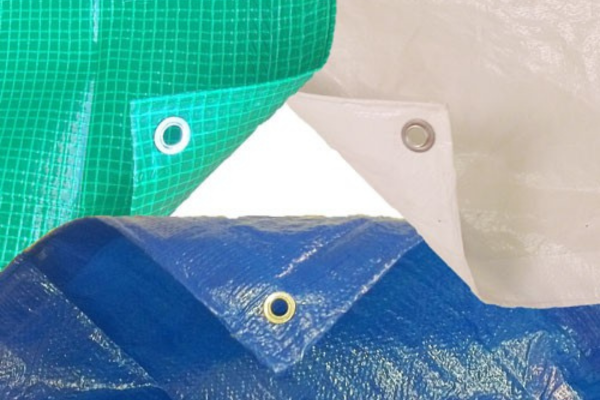
A tarpaulin, or tarp for short, is a flexible sheet of water-resistant or waterproof material, most commonly polyethylene, canvas, or vinyl-coated polyester. Stock tarps are produced in standard rectangular dimensions, typically with grommets spaced along the perimeter for tie-down using rope or bungee cord.
Material weight is the primary driver of durability. Lightweight polyethylene tarps in the 5–8 oz range are intended for short-term use and degrade quickly under sustained UV exposure. Heavier canvas and vinyl tarps in the 12–22 oz range offer significantly longer service life but remain limited by their rectangular geometry.
Where Stock Tarps Work Well
- Temporary coverage during transport or short-term storage
- Construction site applications where the cover will be replaced within months
- Situations where exact fit is not critical and the asset being covered has tolerance for wind movement and water pooling
Where Stock Tarps Are Likely To Underperform
- Long-term outdoor storage of equipment with irregular geometry
- High-wind environments where loose material acts as a sail
- Sub-zero conditions where standard polyethylene becomes brittle and tears at fastening points
What Is a Custom Equipment Cover?
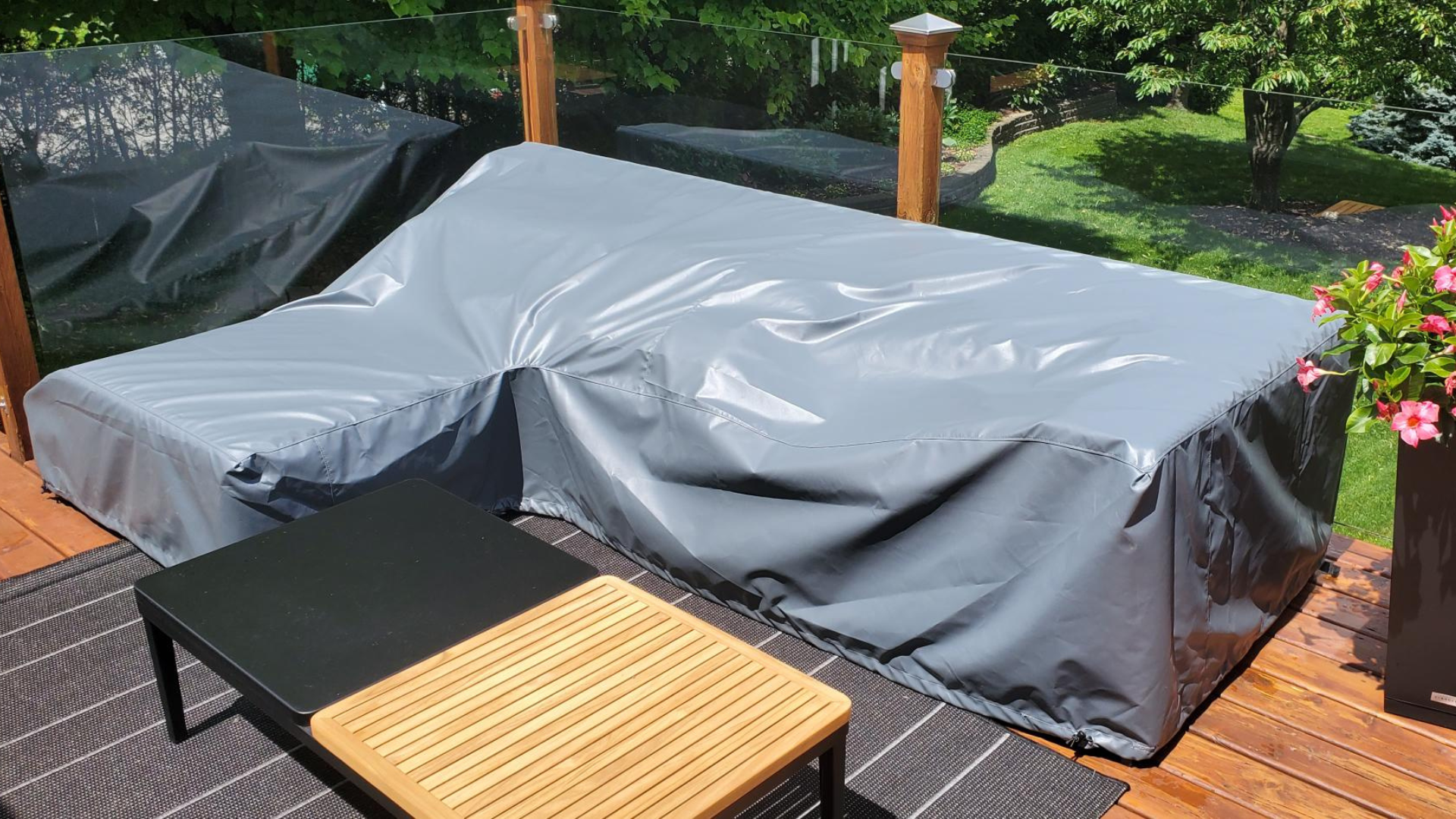
A custom equipment cover is fabricated to the dimensions and contours of a specific asset. The defining characteristics are material specification, seam construction, and fastening system, not just the fact of being made-to-order.
Material Specification
The industry baseline for outdoor capital equipment coverage is reinforced vinyl in the 18–22 oz weight range. Lighter weights under 12 oz lack the abrasion resistance for repeated use. The vinyl should be interwoven with a polyester scrim for tear resistance and treated for UV stability and mildew resistance.
Cold-Crack Rating: Canadian Climate Consideration
For Canadian climates, cold-crack ratings of at least -30°C should also be taken into account. Untreated vinyl becomes brittle in sub-zero temperatures and will fracture at fold lines and grommet holes.
Seam Construction
Stitched seams allow water penetration through needle holes, regardless of material. Radio-frequency welded or heat-welded seams fuse the material into a continuous waterproof barrier. For applications where full waterproofing is required, welded seams are the specification standard.
Fit and Fastening
A custom cover is dimensioned to eliminate excess slack, which is the primary cause of wind buffeting and the abrasion damage that follows. Fastening options vary by application and include:
- Drawcord hems with cord locks
- Side-release buckle straps
- D-ring tie-down points at load-bearing locations
- Elasticized bottom hems for smaller equipment
The fastening system should be specified based on wind exposure, frequency of cover removal, and whether the equipment is stationary or transported under cover.
Custom Equipment Covers vs. Stock Tarps: When Should You Choose Each?
|
Factor |
Stock Tarp |
Couverture personnalisée |
|
Coverage duration |
Days to weeks |
Months to years |
|
Equipment value |
Lower-value or replaceable |
Capital equipment |
|
Geometry |
Flat or boxy loads |
Irregular or contoured |
|
Climate exposure |
Mild, short-term |
Multi-season, including winter |
|
Frequency of use |
Single-use to occasional |
Repeated removal and replacement |
|
Wind exposure |
Sheltered |
Open or elevated sites |
The economic case for custom covers strengthens as exposure duration and equipment value increase. A $400 custom cover protecting a $40,000 piece of equipment over five years is straightforward arithmetic. The same $400 spent on stock tarps replaced annually rarely delivers equivalent protection.
While stock tarps often have a lower upfront cost, repeated replacement, increased labour, and the potential for equipment damage can make them more expensive over time. For valuable equipment, custom covers typically offer a lower total cost of ownership.
Manufacturer Selection Criteria
When evaluating custom cover manufacturers, the following specifications should be verified rather than assumed:
- Material weight and composition — request the manufacturer's specification sheet, not marketing copy
- Seam construction method — welded versus stitched, with reinforcement at stress points
- Cold-crack rating — particularly relevant for Canadian operations
- Warranty terms — duration and what conditions void coverage
- Lead time and revision policy — custom fabrication implies dimensional iteration
Outdoor Covers Canada is one example of a Canadian manufacturer producing covers to these specifications, offering 18 oz and heavier reinforced vinyl, welded seams, cold-rated materials, and made-to-measure fabrication for industrial and equipment applications. Buyers should compare specifications across manufacturers before committing.
Choose Custom Equipment Covers From Outdoor Covers Canada
The choice between a stock tarp and a custom equipment cover is a specification decision, not a budget decision. Stock tarps remain appropriate for short-term, low-stakes coverage. For capital equipment exposed to Canadian outdoor conditions over multiple seasons, the relevant questions concern material weight, seam construction, cold-crack rating, and fastening system, not whether a stock product happens to fit.
Buyers evaluating custom cover manufacturers should request specification sheets, verify warranty terms, and confirm that the fabricator can meet the operational conditions of the asset being protected. Outdoor Covers Canada manufactures custom equipment covers using heavy-duty reinforced vinyl, welded seams, and cold-weather-rated materials specifically designed for Canadian industrial and commercial environments.
Ready to protect your equipment? Contact Outdoor Covers Canada for a custom equipment cover designed to fit your machinery, operating environment, and long-term protection requirements.
Frequently Asked Questions
Custom covers fabricated from 18 oz or heavier reinforced vinyl with welded seams typically have a service life of 5–10 years under outdoor exposure, depending on UV intensity and handling. Stock polyethylene tarps in the 5–8 oz range generally last one season in continuous outdoor use. Heavier stock tarps perform better but are still limited by stitched seams and poor fit.
For capital equipment exposed to multi-season conditions, the cost differential is usually recovered within the first replacement cycle of a stock tarp. The relevant comparison is not cover-to-cover price but total cost over the asset's protected lifespan, including labour to re-secure ill-fitting tarps and any damage caused by inadequate coverage.
Reinforced vinyl in the 18–22 oz weight range with a polyester scrim, treated for UV stability, and rated to a cold-crack temperature of at least -30°C is the standard specification for Canadian outdoor use. Canvas covers, while traditional, lack the waterproofing and freeze resistance of modern vinyl for unsheltered applications.
In principle, yes. Custom manufacturers fabricate covers for equipment ranging from compact generators to large agricultural and construction machinery with complex geometry. The practical limits are minimum order requirements, lead time, and the availability of dimensional information supplied by the buyer or templates taken on-site.
Water-resistant materials shed light precipitation but allow penetration under sustained exposure or pressure. Waterproof covers, combined with welded or sealed seams, prevent water passage even during prolonged rainfall or snow accumulation. Stitched seams compromise waterproofing because needle holes allow capillary water entry regardless of the base material's rating.
Most manufacturers provide measurement guides specifying the dimensions required — typically length, width, height, and key contour points. Critical measurements include the widest cross-section, attachment-point clearances, and any protrusions such as exhaust stacks or hydraulic arms. Photographs from multiple angles supplement measurements and help fabricators identify features that affect cover geometry.
Warranty terms vary by manufacturer, typically ranging from one to five years, and generally cover material defects and seam failure under normal use. Warranties usually exclude damage from improper handling, modification, or use outside specified conditions. Buyers should request written warranty terms before purchase and verify what evidence is required to make a claim.
Securing systems are specified during the order process and selected based on application. Common options include drawcord hems with cord locks for quick removal, buckle straps for high-wind environments, D-ring tie-downs at structural points, and elasticized hems for smaller equipment. The fastening system is as important as the material specification in determining how the cover performs in service.
Yes. Minor tears, punctures, and seam damage can often be repaired using compatible vinyl patch materials or welded repairs, depending on the cover's construction. For extensive damage or severe wear, replacement may be the more practical and cost-effective option.