
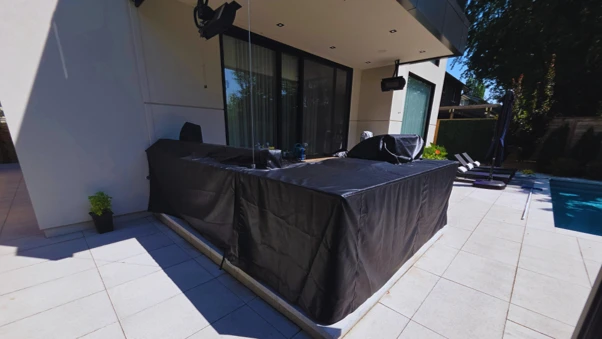
Custom Outdoor Covers in Canada for Outdoor Kitchens
Posted by Outdoor Covers Canada on 7th Aug 2026
Custom Outdoor Furniture Covers For Canada’s New Backyard
Built-in stone outdoor kitchens, wood-fired pizza ovens, sprawling firepit lounges, and uniquely configured modular living sectionals are becoming increasingly popular in Canada. These non-standard outdoor spaces often require custom outdoor furniture covers and tailored protection rather than one-size-fits-all covers. Driven by elevated housing costs and expensive travel, homeowners across the country are choosing to invest where they already live.
A found that 49% of Canadians were planning, executing, or had recently completed home improvements, while 60% of Canadians chose to renovate instead of selling their homes.
However, standard covers for outdoor kitchen equipment and modular living furniture may not be built for bespoke construction. Leaving an expensive custom outdoor kitchen or an expansive modular sectional exposed to harsh frost, heavy snow loading, and destructive freeze-thaw cycles leads to rapid deterioration, masonry cracking, and water damage.
To safeguard these high-value investments, homeowners require tailored protection engineered specifically for local weather conditions. This guide breaks down the financial risk of weather exposure, explains why mass-market options fail elaborate outdoor layouts, and walks you through how to measure for and order custom outdoor covers in Canada—including custom outdoor kitchen covers, modular patio furniture covers, and heavy-duty BBQ and firepit covers built for the Canadian climate.
Key Takeaways
- Canadians are treating their yard as functional square footage, often redirecting travel and moving budgets into permanent backyard upgrades, such as built-in outdoor kitchens, pizza ovens, firepit lounges, and modular sectionals
- A built-in outdoor kitchen commonly represents a five-figure investment; leaving it exposed to freeze-thaw cycles, UV, and moisture accelerates corrosion, cracking, and appliance failure.
- Off-the-shelf covers are designed for standard rectangles and common grill dimensions. They rarely fit L-shaped islands, curved sectionals, or multi-appliance layouts, leaving gaps where water and debris collect.
- Custom outdoor covers in Canada are made to a structure's exact measurements, eliminating pooling, wind billowing, and abrasion caused by loose fabric.
- Accurate measurements, including length, depth, height at multiple points, plus protrusions like side burners and countertop overhangs, is the most important step in ordering a custom cover.
How the Canadian Backyard Became Permanent Square Footage
When a homeowner finishes a basement or adds a sunroom, they insure it, heat it, and carefully maintain it. The modern backyard deserves that exact same logic. A built-in stone island featuring an integrated grill, side burners, outdoor refrigeration, and quartz countertops can be unofficially considered as fixed architectural infrastructure, even if they aren’t directly attached to your home.
Unlike standard dining sets or lightweight chairs that can easily be dragged into the garage come October, these installations are built to stay outdoors year-round. Their only line of defence against a Canadian winter, which boasts freeze-thaw cycles, heavy wet snow load, ice buildup, and intense spring UV radiation, is the barrier placed over them.
Because standard off-the-shelf options rarely accommodate custom dimensions, protecting these setups requires custom outdoor kitchen covers and tailored, heavy duty winter patio covers designed to withstand harsh northern elements. Without an engineered fit, your protective barrier quickly becomes a liability.
What Unprotected Weather Exposure Actually Costs
Leaving custom outdoor investments exposed to Canadian weather leads to predictable, costly damage patterns well-documented by appliance manufacturers and stone-care experts:
- Built-in Appliances & Grills: Trapped moisture combined with airborne contaminants causes pitting corrosion and tea staining on stainless steel, rapidly degrading burners, igniters, and hinges. Fitting your setup with premium BBQ covers prevents moisture from pooling inside sensitive electronic ignition systems.
- Natural Stone, Mortar, & Grout: Water easily penetrates porous stone and mortar joints. During a freeze-thaw cycle, that trapped water expands, cracking expensive stone countertops and masonry facades—repairs that routinely cost thousands of dollars.
- Modular Sectionals & Cushions: Unprotected UV exposure degrades performance fabrics over time. Worse, unsealed seams allow rain and melted snow into deep foam cores, breeding mold and mildew that ruin high-end upholstery. Investing in specialized custom patio furniture covers can help seal out moisture while allowing proper airflow to eliminate trapped dampness.
- Pizza Ovens & Masonry Firepits: Moisture absorbed by refractory firebrick inside pizza ovens and firepits causes spalling (surface flaking and cracking) when the unit is fired up in the spring.
Compared with the cost of a high-end backyard installation, a properly fitted custom cover can be a relatively small investment that helps reduce the risk of premature weather-related damage. To learn more about measuring your setup accurately, read our step-by-step guide on how to measure for custom patio covers.
Heavy Duty Custom Outdoor Covers vs. Off-the-Shelf Covers
Universal covers are manufactured for a hypothetical middle, often a 64-inch grill, a rectangular dining set, or a standard three-seat sofa. Bespoke spaces exist precisely because they reject those templates. Off-the-shelf covers can cause gaps and exposed edges, water pooling that freezes into ice sheets, wind billowing that abrades stainless and stone, and trapped condensation against the very surfaces the cover is meant to protect.
Not all cover fabrics are designed for Canadian winter conditions, so the material should be selected based on the expected temperature, moisture, UV exposure, and intended season of use. The table below compares the two approaches on both dimensions:
|
Factor |
Off-the-Shelf Cover |
Heavy Duty Custom Cover |
|
Fit and coverage |
Sized for standard shapes; L-shaped islands and modular sectionals are left with gaps and exposed edges |
Patterned to the structure's exact geometry, including protrusions and multi-height features |
|
Water pooling |
Excess fabric sags between support points, collecting water that freezes and stresses seams |
Tailored fit eliminates slack, so precipitation sheds instead of pooling |
|
Wind performance |
Loose material billows, chafes surfaces, and can pull free in storms |
Secure fastening — buckles, drawcords, or elastic hems — rated for sustained wind exposure |
|
Condensation |
Sealed fit without venting traps humidity against stainless and stone |
Engineered air vents release moisture while the waterproof outer layer blocks intrusion |
|
Cold-weather fabric |
Standard fabric stiffens and splits in deep sub-zero temperatures |
Cold-rated materials can remain flexible in demanding Canadian winter conditions, depending on the fabric selected. |
|
UV resistance |
Uncoated fabric chalks and degrades within one or two seasons |
UV-stabilized coating preserves fabric integrity over multiple seasons |
|
Seams and stress points |
Corners and handle contact points are where traditional covers may fail first |
Reinforced seams and padded contact points at known stress locations |
|
Service life |
Often fails within one to two winters |
Built for multi-season, year-round outdoor use |
A properly built custom cover solves the fit problem by design and the fabric problem by specification. The same material criteria apply to standard-format protection, including patio furniture covers, dining table set covers, and barbecue and firepit covers, for the portions of a backyard that do follow standard dimensions. The full case is covered in our article on the benefits of custom outdoor covers.
How to Measure for Custom Outdoor Furniture Covers?
Accurate measurement is the foundation of a proper fit. Follow this sequence before ordering:
- Sketch the footprint. Draw the structure from above, noting its overall shape — straight run, L-shape, U-shape, or curved.
- Measure length and depth at the widest points. Include countertop overhangs, not just the base cabinetry.
- Measure height at multiple locations. Record the tallest point (e.g., a grill hood or pizza oven dome) and the standard counter height separately.
- Document protrusions. Side burners, towel bars, handles, backsplashes, and raised bar ledges all affect the pattern.
- For modular sectionals, measure each configuration segment — chaise depth, corner angles, and back height — or measure the assembled footprint if the layout is permanent.
- Add clearance guidance only if instructed. Reputable manufacturers build tolerance into the pattern; do not pad your numbers arbitrarily.
Submit these measurements through the custom barbecue and kitchen covers or custom patio furniture covers order process, where patterns are produced to specification.
Why Choose Outdoor Covers Canada
- Bespoke, Precision Fit For Your Outdoor Kitchen Or Modular Living Equipment
- Canadian Cold-Crack, UV-stabilized Protection
- Engineered Climate Breathability
- Built for Multi-Appliance Complexity
- Storm-Proof Security System
- Commercial-Grade Fabric Options
Custom Protection with Outdoor Covers Canada
Custom outdoor covers in Canada exist to provide homeowners investing in modular living with the same quality that they expect from their permanent outdoor kitchens and backyard installations: measured to the structure, built for the climate, and engineered to last as long as the space itself.
Homeowners planning to winterize a bespoke outdoor kitchen or modular lounge can begin by taking measurements using the steps above and submitting them through Outdoor Covers Canada's custom cover ordering process.
Frequently Asked Questions
Pricing depends on dimensions, fabric grade, and complexity of the shape. A custom cover for a full outdoor kitchen island typically costs more than a standard grill cover but remains a small fraction of the installation it protects. Request a quote with exact measurements for accurate pricing, since L-shapes and multi-height structures affect the pattern.
Universal covers work for standard-dimension grills and rectangular furniture. For built-in islands, curved sectionals, or multi-appliance layouts, universal covers leave gaps, pool water, and billow in wind. If your structure was custom-built or your sectional has a non-standard configuration, a custom cover is the only option that fully encloses it.
Sketch the footprint from above, then record length and depth at the widest points, including countertop overhangs. Measure height at both the counter and the tallest feature, such as a grill hood. Note all protrusions — side burners, handles, backsplashes. Submit these figures as measured; the manufacturer builds fitting tolerance into the pattern.
Both. A waterproof outer layer blocks rain and snow, while integrated air vents allow trapped humidity to escape. A fully sealed, non-breathable cover traps condensation against stainless steel and stone, causing the corrosion and mildew it was meant to prevent. Quality custom covers combine waterproof fabric with engineered venting.
Yes, provided the cover and the furniture are suitable for winter conditions. Choose a cover material designed for the expected temperature range, with appropriate weather resistance, secure fastening, and ventilation.
Covers do not cause mold; trapped moisture does. Mold appears when a non-breathable cover seals damp furniture or humidity underneath. Prevent it by covering furniture only when dry, choosing covers with air vents, and ensuring a snug fit that stops rain from entering while still allowing airflow.
A well-made custom cover using UV-stabilized, cold-rated fabric typically lasts several seasons of year-round Canadian use — significantly longer than lightweight universal covers, which often fail within one or two winters. Longevity depends on fabric grade, fit (loose covers abrade themselves), and basic care such as brushing off heavy snow accumulation.
Yes, whenever it is not in use for extended periods. Summer exposure brings UV degradation, rain, pollen, bird droppings, and dust that affect burners and finishes. Allow the grill to cool completely before covering. A fitted premium BBQ cover used year-round is what preserves appliance function and appearance long-term.