
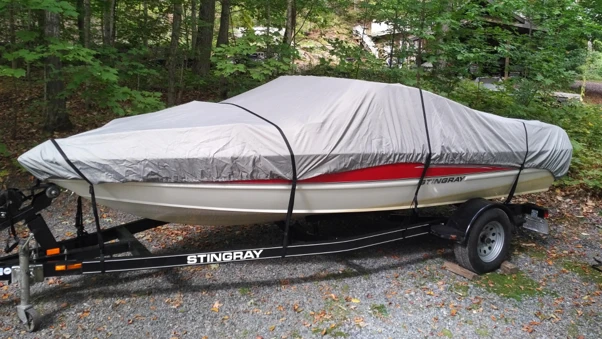
Selecting The Right Boat Cover for Heavy Snow: Denier and Tie-Downs
Posted by Outdoor Covers Canada on 10th Nov 2026
Selecting The Right Boat Cover for Snow: Denier, Support, & Tie-Downs
For heavy snow, a winter boat cover needs 600-denier solution-dyed marine polyester, a support that keeps the top pitched, and webbing straps anchored to the trailer frame. Canoes and kayaks stored inverted can use 300-denier covers. Denier alone does not stop a collapse; cover shape and anchoring do.
Two things damage a boat stored outside in winter: water that freezes inside it, and snow that builds up on the cover. Water left in the hull freezes and expands. Snow stacks on the cover until it sags, pools and tears. Outdoor Covers Canada, an Ontario supplier, stocks covers for trailered boats and paddle craft. The specifications below explain what holds up.
Key Takeaways
- 600D marine polyester is the practical floor for boats.
- Denier measures yarn weight, not snow-load strength.
- A pitched support prevents snow pooling and collapse.
- Anchor straps to the trailer frame, never the hull.
- Store canoes and kayaks inverted under 300D covers.
Table Of Contents
- Why does freezing water damage boat and canoe hulls?
- How much snow weight sits on a winter boat cover?
- What denier rating does a winter boat cover need?
- What does denier actually measure?
- Which denier suits each type of watercraft?
- How do I set up a support under a winter boat cover?
- Choosing Between a Pole and a Frame
- Positioning the Support
- Setting the Height and Pitch
- Protecting the Cover Fabric
- Purchasing a Support System
- Which tie-down mechanisms hold a cover under heavy snow?
- Where should winter straps anchor?
- Is a summer boat cover different from a winter setup?
- How should canoes and kayaks be covered for winter?
- How Outdoor Covers Canada Matches Covers to Canadian Snow
- Frequently Asked Questions
Why Does Freezing Water Damage Boat And Canoe Hulls?
Freezing water expands and cracks whatever contains it. According to the , ice is about 9% less dense than liquid water. That extra volume splits engine blocks, cooling passages and livewell lines, and can damage sealed compartments that hold standing water.
A cover cannot fix water already inside the hull. It can stop new water from entering. Snowmelt that pools on a sagging cover often drips into the cockpit, then refreezes overnight. Preventing that cycle of pooling, dripping, and freezing is the core of any good winterizing strategy.
How Much Snow Weight Sits On A Winter Boat Cover?
30 cm of fresh snow puts about 340 kg on a 16-foot boat cover. The same depth of settled, older snowpack weighs about twice that, roughly 690 kg. The range depends on snow density. Canadian building-code data assumes about 1 kN/m³ (about 100 kg per cubic metre) for new snow. It assumes about 2 kN/m³ for settled snowpack east of the continental divide, per of the National Building Code of Canada, Division B.
Outdoor Covers Canada applies those unit weights to two common Venture cover sizes. The figures below are estimates for 30 cm of snow lying flat on the cover. Snow gets denser as it settles but not heavier. Weight builds when new snow or rain lands on top.
|
Cover size |
Covered area |
30 cm fresh snow (≈1 kN/m³) |
30 cm settled snowpack (several storms) (≈2 kN/m³) |
|
14'–16' x 90" fishing boat |
11.2 m² |
≈340 kg |
≈690 kg |
|
22'–24' x 116" bowrider |
21.6 m² |
≈660 kg |
≈1,330 kg |
Rain makes the problem worse. The same code appendix notes that the heaviest loads often occur when rain soaks an existing snowpack. The same appendix puts old snow at 2 to 5 kN/m³, and program puts wet snow at roughly four times the density of dry snow.
A flat cover can’t carry that load on its own. It sags, ponds and tears unless a support underneath takes the weight. The load must transfer to a support underneath and then to the trailer.
What Denier Rating Does A Winter Boat Cover Need?
A trailered boat stored outdoors needs at least 600-denier solution-dyed polyester with a breathable polyurethane inner treatment. That weight resists abrasion at contact points and holds stitched strap anchors under tension. Higher denier adds weight and cost but does not replace a support structure.
What Does Denier Actually Measure?
Denier is the mass in grams of 9,000 metres of a single yarn. It describes yarn thickness, not finished fabric strength. Weave density, coating and seam construction decide how a fabric performs under snow. In our experience, a 600D cover over a ridge support outlasts a heavier cover lying flat and ponding water.
Which Denier Suits Each Type Of Watercraft?
|
Craft and storage |
Recommended fabric |
Why |
|
Trailered runabout, fishing boat or bowrider |
600D solution-dyed polyester |
Large flat area; carries strap tension and abrasion at the windshield and rails |
|
Canoe or kayak, inverted on a rack |
300D solution-dyed polyester |
Narrow, curved hull sheds snow; low load per metre |
|
Odd-shaped craft or equipment |
18 oz cold-rated vinyl (custom) |
Fully waterproof; must be vented or removed to release condensation |
Outdoor Covers Canada’s Venture boat line uses 600D solution-dyed ShurTex polyester with a breathable polyurethane inner treatment. Venture canoe and kayak covers use 300D solution-dyed marine polyester. Owners comparing custom boat covers against universal sizes should weigh fit first; a snug cover sags less.
How Do I Set Up A Support Under A Winter Boat Cover?
Choosing Between a Pole and a Frame
A support goes under the cover along the boat’s centreline and lifts the fabric into a ridge so snow and meltwater run off to the sides. Use either a pole or a frame. Outdoor Covers Canada notes that an adjustable support pole is a solution for most universal-fit covers to prevent sagging from pooled snowmelt that freezes and stretches the fabric. A support frame is better suited for larger craft with wide cockpits to ensure snow sheds off the entire surface evenly.
Positioning the Support
Place the support centrally in the widest and lowest part of the boat, typically right in the main cockpit between the windshield and the transom, where the cover is otherwise most likely to dip and catch water.
Setting the Height and Pitch
One benefit is to aim for a height that creates a distinct, sloped peak. The pitch needs to be steep enough so that rain, ice, and snow slide off the sides smoothly rather than accumulating and stretching the fabric.
Protecting the Cover Fabric
Pad the top of the support so it doesn’t wear through the fabric. Using a broad, domed mushroom cap or a foam block over the top of the pole distributes the pressure evenly to prevent tearing under heavy winter snow loads.
Purchasing a Support System
You can purchase a boat cover support pole system, which typically includes the telescoping pole, base, and protective top cap, from local marine retailers to pair with your cover.
Which Tie-Down Mechanisms Hold A Cover Under Heavy Snow?
Effective winter boat covers need two systems working together: a shock-cord hem to seal the perimeter and webbing straps to resist lift and sag. The hem keeps wind and snow from entering underneath. The straps carry the load and stop the cover from sliding when snow shifts.
|
Mechanism |
Job in winter |
Limitation |
|
Shock-cord (elastic) hem |
Seals the perimeter against drifting snow |
Does not resist vertical load on its own |
|
Webbing straps with buckles |
Transfer load and resist wind lofting |
Need a solid anchor below the hull |
|
Rear vents |
Release moisture and reduce wind lift |
Must face away from prevailing wind |
|
Rope or bungee ties |
Temporary fixes only |
Stretch, fray and loosen through freeze-thaw cycles |
Venture boat covers combine a shock-cord hem, heavy-duty webbing straps sewn over the top, and rear vents.
Where Should Winter Straps Anchor?
Straps should anchor to the trailer frame or cradle, never to the hull or rub rails. Snow load pulls the cover down, and a hull-anchored strap transfers that pull onto gelcoat and fittings. Owners should re-tension straps after the first heavy snowfall, once the fabric has stretched and settled.
Is A Summer Boat Cover Different From A Winter Setup?
A cover sized for dock and trailering duty can serve through winter if its setup changes. The common failure is fitting a summer setup to a winter load.
|
Setup element |
Summer and trailering |
Winter storage |
|
Top profile |
Follows the hull and windshield |
Pitched over a centre support so snow slides off |
|
Strap anchors |
Trailer or bunk points for highway wind |
Trailer frame, re-tensioned after first snowfall |
|
Venting |
Optional |
Open, facing away from prevailing wind |
|
Checks |
After each trip |
Clear snow before it compacts; inspect monthly |
How Should Canoes And Kayaks Be Covered For Winter?
Canoes and kayaks should sit inverted or on their sides on a rack, under a fitted, breathable cover. Inverted storage lets snow slide off the curved hull. It also keeps water out of the cockpit, where freezing can damage foam and sealed bulkheads.
Good canoe covers for outdoor storage close fully around the hull. Venture canoe and kayak covers use a half-hull-length zipper and come in ten sizes, from 11'6" kayaks to 19'6" tandems. A kayak cover left open at one end admits mice as well as snow. Outdoor Covers Canada’s summer canoe and kayak storage guide covers rack position and hull orientation in detail.
How Outdoor Covers Canada Matches Covers To Canadian Snow
When searching for reliable boat covers Canada shoppers can trust, note that Outdoor Covers Canada is an independent Canadian business based in Ontario with custom fabrication produced in the country. Its watercraft range covers boats from 14-foot aluminum fishing hulls to 24-foot bowriders, plus canoes, kayaks, PWCs and pedal boats.
Winterize the hull, fit a 600D cover over a pitched support, anchor straps to the trailer, and clear snow before it compacts. Owners can compare sizes in the boat cover range or the full watercraft covers collection. For an unusual hull or a fit question, contact Outdoor Covers Canada with the boat’s length and beam. Cleaning and seasonal care steps are on the product care page.
Frequently Asked Questions
The practical minimum is 600-denier solution-dyed polyester for a trailered boat. That weight holds stitched strap anchors under tension and resists abrasion at windshields and rails. Denier only measures yarn weight, so coating and seam quality matter too. A 600D cover with a breathable polyurethane inner treatment, fitted over a pitched support, handles typical Canadian snow better than a heavier fabric lying flat.
No, a higher denier does not guarantee better snow performance. Denier describes yarn thickness, not the strength of the finished fabric or the cover’s shape. A heavy cover that lies flat still ponds water and stretches under load. Support structure, strap anchoring and fit decide whether a cover survives a wet snowfall. Heavier fabric mainly adds abrasion resistance, weight and cost.
Yes, a support is needed for any boat stored outdoors where snow accumulates. A centre pole or frame lifts the cover into a pitched ridge so snow slides off. Without it, the cover sags between the windshield and the transom. Meltwater then pools, refreezes and adds weight each cycle until the fabric or the stitching fails.
Straps should anchor to the trailer frame or storage cradle, not to the hull. Pass webbing straps under the trailer and buckle them snug, with the shock-cord hem pulled tight around the perimeter. Re-tension every strap after the first heavy snowfall. Avoid rope and bungee ties for winter; they stretch and loosen through repeated freeze-thaw cycles.
Yes, a well-made trailering cover can work through winter if the setup changes. Venture boat covers are built as both storage and trailering covers. The changes are a pitched support underneath, straps anchored to the trailer frame, vents facing away from the wind, and regular snow clearing. A cover with worn straps or a torn hem should be replaced before winter.
Yes, snow should be cleared before it compacts or absorbs rain. Settled snow is about twice as dense as new snow, so each new storm or rain adds weight to a pack that is already there. Clear snow before the next snowfall or rain lands on it. Use a soft broom or brush and pull snow toward the sides rather than pushing down on the cover. Never use a shovel edge or ice chipper on fabric.
Yes, a canoe can be stored outside all winter if it is supported and covered correctly. Place it upside down or on its side on a padded rack, off the ground. Fit a breathable cover with a full-length closure so snow and rodents stay out. A 300-denier cover is sufficient because the curved hull sheds most snow.
No, not for most boats left covered all season. Cold-rated vinyl is fully waterproof and stays flexible in deep cold but it does not breathe. Condensation from the hull collects underneath and feeds mildew. Outdoor Covers Canada advises removing or venting vinyl covers regularly. Breathable marine polyester sheds snow while letting moisture escape, which suits long unattended storage.