
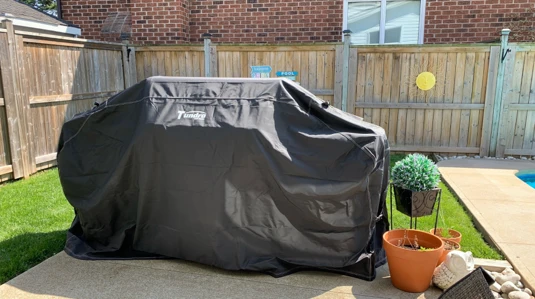
BBQ Cover Features That Matter: 7-Point Buyer Checklist
Posted by Outdoor Covers Canada on 22nd Sep 2026
7 Essential Features of a Quality BBQ Cover
Whether you are shopping for standard barbecue covers, custom bar b q covers, or researching how to cover a barbecue grill before winter, the goal is to protect your investment from rust, UV damage, and harsh weather. However, most retail listings rely on vague marketing adjectives like "heavy-duty" or "all-weather" rather than providing actual specifications. To ensure true year-round protection, particularly when shopping for heavy-duty polyester options, a quality bbq cover must include these seven verifiable features:
- Fabric Denier of 600D or Higher: Thick, abrasion-resistant material that withstands friction at the grill's corners and edges.
- Laminated Waterproof Barrier: A bonded polyurethane (PU) or PVC inner layer, rather than a temporary water-resistant surface spray.
- Hooded Top Vents: Strategically placed openings that release trapped condensation and ambient humidity without letting rain in.
- Stated Cold-Flex Rating: Purpose-formulated materials that remain pliable in sub-zero winter temperatures without freezing or cracking.
- Strap-and-Buckle Fasteners: Mechanical securing systems that route beneath side tables to prevent wind lift and seam stress.
- Measured Fit: Sizing based on the grill's physical dimensions
- Reinforced Seams & Warranty: Double-stitched or sealed construction backed by a clearly published manufacturer warranty.
Key Takeaways
- A quality bbq cover has seven verifiable features: fabric denier of 600D or higher, a laminated waterproof barrier rather than a spray-on finish, hooded top vents, a stated cold-flex rating, strap-and-buckle securing, double-stitched or sealed seams, and a published warranty.
- If a listing does not provide information about material construction, water protection, or temperature suitability, it is harder to determine whether the cover is appropriate for year-round use.
- Covers fail at seams, corners, and fastenings before the fabric panel wears out, so construction matters as much as material.
- Fit is a specification: measure the grill's width at the side tables and size up by a small margin.
Heavy Duty Is A Vague Term
BBQ covers rarely fail from a single downpour. Material analysis published by attributes most early failures to UV exposure, trapped moisture, constant wind movement, and cold-induced cracking, with seams and corners giving out before the fabric panel does. None of those failure modes is addressed by the phrase "heavy duty," which has no industry-standard definition. Evaluation therefore starts with what can be measured: fabric weight, coating type, vent design, temperature rating, fastening hardware, seam construction, and warranty term.
The Seven Essential Features of a Quality BBQ Cover
1. Fabric Denier of 600D or Higher
Denier measures the linear mass of the yarn in the outer shell; a higher number means a thicker, more abrasion-resistant thread. Entry-level covers use 150D–420D polyester, which wears through at grill corners and side-table edges within a season. Experts consulted by cite 600D as the practical floor for a heavy-duty rating, and premium lines use 900D–1000D fabrics. How to verify: the denier should appear as a number on the product page; "thick polyester" without a figure is not a specification.
2. A Waterproof Barrier Layer
Waterproof protection can come from a suitable PU, TPU, PVC, or other waterproof coating or barrier, depending on the fabric construction. (Note: Ultra-premium solution-dyed acrylics, like Sunbrella, operate differently and rely on a tight weave rather than laminates). Look for a named PU or TPU coating in the description, and for sealed or double-stitched seams, since seams are where water enters a coated fabric. Avoid standard PVC linings, which are prone to stiffening and cracking.
3. Hooded Top Vents
A sealed cover traps condensation from a cooling grill and ambient humidity against burners, grates, and igniters, which accelerates corrosion. Vents relieve this, but only if they sit at the high point of the cover, where warm air collects, and only if they are hooded so precipitation cannot enter. Product photographs should show both the vent position and the hood above the opening; otherwise, it’s not verifiable that said products have them..
4. A Stated Low-Temperature Flex Rating
Economy PVC-coated fabrics stiffen and crack below roughly −10°C to −15°C, depending on formulation, which ruins the waterproof barrier the first time the cover is pulled off for a winter cook. Cold-rated materials remain pliable at sustained sub-zero temperatures. Outdoor Covers Canada rates its Tundra Supreme barbecue cover to handle extreme swings, from ambient summer temperatures of +40°C (withstanding much higher direct-sun surface heat) down to a freezing −40°C. The absence of any low-temperature rating on a product listing can signal that it’s not built for severe winter use. be a red flag for winter use.
5. Mechanical Securing: Straps and Buckles
Wind lift is the leading cause of seam failure, because a flapping cover works its stitching loose long before the fabric wears out. Securing methods rank predictably: side tension straps with buckles hold under snow load and release without bending; drawcords loosen over time; hook-and-loop tabs lose grip once dirt enters the hook fabric. Confirm the straps route beneath the side tables rather than around the cart base.
6. Fit Derived From Measurement, Not Size Labels
Measure the grill's width at its widest point with side tables in position, then depth and height, and choose the size that exceeds the width by a small margin. Too large balloons in wind; too small stresses seams during installation. Outdoor Covers Canada publishes fitment dimensions on each listing (the 63" Tundra Supreme measures 63"W × 28"D × 46"H). Built-in grills and outdoor kitchens outside stock sizes need a custom barbecue cover made from photographs and measurements.
7. Seam Construction and a Published Warranty
Double-stitched seams, reinforced corners, and rubber or webbing handles separate multi-season covers from single-season ones because they address the stress points where covers actually fail. A published warranty term is the manufacturer's own statement of expected service life, and more reliable than a lifespan claim in marketing copy. How to verify: read the warranty page, not the product blurb. Outdoor Covers Canada backs its Tundra line with a two-year warranty published on its warranty page.
Choosing a BBQ Cover on Specs
|
Essential Feature |
Quality Specification (Year-Round Use) |
Economy Trait (Seasonal/Storage) |
|
1. Fabric Weight (Denier) |
600D to 1000D (specifically stated as a number). Resists abrasion at corners. |
150D to 420D or vaguely listed as "thick polyester." Wears through quickly. |
|
2. Water Protection |
Quality Specification: Laminated PU or TPU barrier. Truly waterproof layer bonded to the shell without brittle PVC. |
Spray-applied finish. Merely water-resistant; degrades as fabric flexes. |
|
3. Ventilation |
Hooded top vents. Placed high to release condensation without letting rain in. |
Unvented or unhooded. Traps moisture against the grill, accelerating rust. |
|
4. Temperature Rating |
Stated cold-flex rating (e.g., down to -40°C). Remains pliable in winter. |
No rating provided. Economy PVC stiffens and cracks between -10°C and -15°C. |
|
5. Securing Method |
Straps and buckles. Mechanical fasteners routed beneath side tables. |
Drawcords or hook-and-loop. Drawcords loosen; hook-and-loop loses grip from dirt. |
|
6. Fit & Sizing |
Measured physical dimensions. Sized to exceed grill width by a small margin. |
Generic size labels. Often too large (balloons in wind) or too small (stresses seams). |
|
7. Construction & Warranty |
Double-stitched seams & published warranty. Manufacturer states expected service life. |
Standard seams & marketing hype. Relies on terms like "lifespan" with no formal backing. |
Outdoor Covers Canada carries fitted barbecue covers sized for the grills most commonly sold in Canada and fabricates custom barbecue and outdoor kitchen covers domestically. Its in-house Tundra line, developed for Canadian freeze-thaw conditions, is documented feature by feature in the company's guide to heavy duty BBQ covers, and its guide to the best BBQ cover for Canadian seasons applies the same criteria season by season.
Why Choose Outdoor Covers Canada
- Based in Ontario, supplying fitted and custom covers.
- In-house Tundra line handles Canadian freeze-thaw conditions.
- The Tundra line is stated by Outdoor Covers Canada to be rated from +40°C to −40°C.
- Exact fitment dimensions are published on every listing.
- Custom covers are fabricated domestically from your measurements.
- Sized for grills most commonly sold in Canada.
- Backed by a clearly published two-year manufacturer warranty.
Shop Or Contact Us Today
Outdoor Covers Canada publishes these specifications on its product pages. Shop our BBQ covers or request a custom quote for your specific requirements.
Frequently Asked Questions
Yes. An uncovered grill is exposed to UV, precipitation, airborne grit, and pollen year-round, all of which degrade burners, igniters, and finishes faster than covered storage does. A cover with the seven features above costs a fraction of a burner or grate replacement. The one caveat is a poorly vented cover over a damp grill, which traps moisture; hooded vents and a dry grill resolve that.
Yes, whenever the grill is not in use. Summer UV is frequently the primary cause of fading, plastic embrittlement, and fabric degradation, and summer storms deliver rain and windblown debris. A vented cover with handles and quick-release straps is practical to lift on and off daily, and consistent use, not just ownership, is what protects the grill.
They can if used incorrectly. Mildew grows when moisture is trapped against fabric without airflow. Covers with air vents release that humidity, which is why vented covers are recommended over plastic sheeting. Put the cover on only when the furniture is dry, and lift it after prolonged rain so the cushions can air out before it goes back on.
No. Grill covers are not heat resistant; polyester shells and PU or PVC coatings can deform, melt, or fuse to hot surfaces. The maintenance guide from Barbecues Galore recommends running the grill on high for about fifteen minutes to burn off residue, brushing the grates, then allowing a complete cool-down before covering. Covering a warm grill also traps steam against metal parts.
No. A cover that reaches the ground wicks moisture from wet decks and patio stone and blocks the airflow that lets condensation escape underneath. A well-designed cover drops to just a few inches above the ground, fully protecting the lower cabinet, tank, and controls while leaving a necessary 2 to 4-inch gap at the base for ventilation. Tension straps then hold it securely in place without sealing it completely shut.
Usually, yes. A roof blocks direct rain and much of the UV but not wind-driven rain, humidity, dust, pollen, insects, or animal activity. A lighter cover may be adequate in a sheltered location, while fully exposed grills need the complete feature set. If you’re unsure, consider the amount of exposure to these factors that your bbq will have, and whether it will be mostly under an overhang or on an open deck.
Brush off loose debris, then wash with lukewarm water and mild soap using a soft brush. Avoid bleach, solvents, and pressure washers, which strip coatings and weaken seams. Rinse thoroughly and let the cover dry completely before refitting or storing, because a damp cover folded away will develop mildew. Outdoor Covers Canada's product care page lists fabric-specific instructions.
When the grill or outdoor kitchen falls outside standard sizes, has an unusual footprint, or includes attached side burners, islands, or countertops that a stock cover cannot enclose. Custom covers can be built from photographs and detailed measurements and can be specified in a fabric suited to seasonal or year-round use.